
The organizations shaping places also shape how people live.
Architecture, engineering, construction, real estate and related organizations do more than deliver projects.
They shape cities, neighborhoods, infrastructure, workplaces, institutions and the physical conditions of everyday life.
The quality of those outcomes depends not only on technical excellence.
It also depends on how organizations lead, decide, collaborate, develop people and adapt.
Evolve works with organizations shaping the built world to strengthen the human and organizational capacity behind the work.
Technical expertise is only part of the system.
Built-world organizations operate in unusually demanding environments.
Their work is often project-based, multidisciplinary, highly technical and deeply interconnected. Leaders must coordinate across professions, clients, communities, regulators, capital, schedules and long time horizons while maintaining quality and trust.
At the same time, many firms are navigating:
leadership and ownership succession
thin leadership benches
the transition from technical expert to enterprise leader
workforce and talent pressure
changing expectations of managers
executive-team effectiveness
organizational growth and restructuring
AI and workflow redesign
knowledge transfer and apprenticeship
multidisciplinary coordination
culture and trust
climate, resilience and changing market demands
These pressures rarely arrive one at a time.
The challenge is increasingly not simply technical capability. It is organizational capacity.
From technical excellence to enterprise leadership
Many built-world organizations promote leaders because they are exceptional architects, engineers, builders, project leaders or technical specialists.
Greater enterprise responsibility requires a wider field of view.
Leaders must increasingly:
exercise judgment beyond their discipline
lead through other leaders
understand the whole organization
make tradeoffs across competing priorities
influence across functions and stakeholder groups
develop successors
carry culture and institutional knowledge
remain grounded when the answer is not obvious
This developmental shift is central to Evolve’s work.
Technical expertise should not be abandoned as leaders advance. It must become part of a broader capacity to steward the enterprise.
Succession is bigger than replacement.
Across architecture, engineering and construction firms, succession often sits at the intersection of leadership, ownership, institutional continuity and organizational readiness.
A firm may know who is next without knowing whether the successor is ready.
It may have an ownership transition plan without sufficient leadership depth.
It may be transferring authority without transferring judgment, relationships or institutional knowledge.
It may be preparing a new CEO while the executive team, governance structure or organization itself remains designed for the previous era.
Evolve works with leaders and organizations around:
successor readiness
leadership-bench development
enterprise leadership development
executive advisory during transition
executive-team effectiveness
organizational readiness
role and authority clarity
governance and leadership relationships
The question is not only who comes next. It is what must become true for the next chapter to succeed.
Leadership development belongs inside the work.
We do not believe leadership development should sit apart from the real organizational demands leaders are carrying.
Our work with the Urban Land Institute Washington Leadership Institute reinforced this directly. Leaders from commercial real estate, architecture, engineering, construction, transportation, planning and related fields developed leadership through the actual complexity of built-environment work rather than through generic leadership instruction.
Participants worked with questions of self-awareness, influence, collaboration, innovation and systems leadership while connecting those ideas to active projects, stakeholder relationships, infrastructure, sustainability and regional development.
Leadership was never discussed in the abstract.
That principle carries across Evolve’s built-world work.
Development becomes more useful when it is connected to the decisions, relationships, projects and responsibilities leaders are actually carrying.
Organizations are part of the places they create.
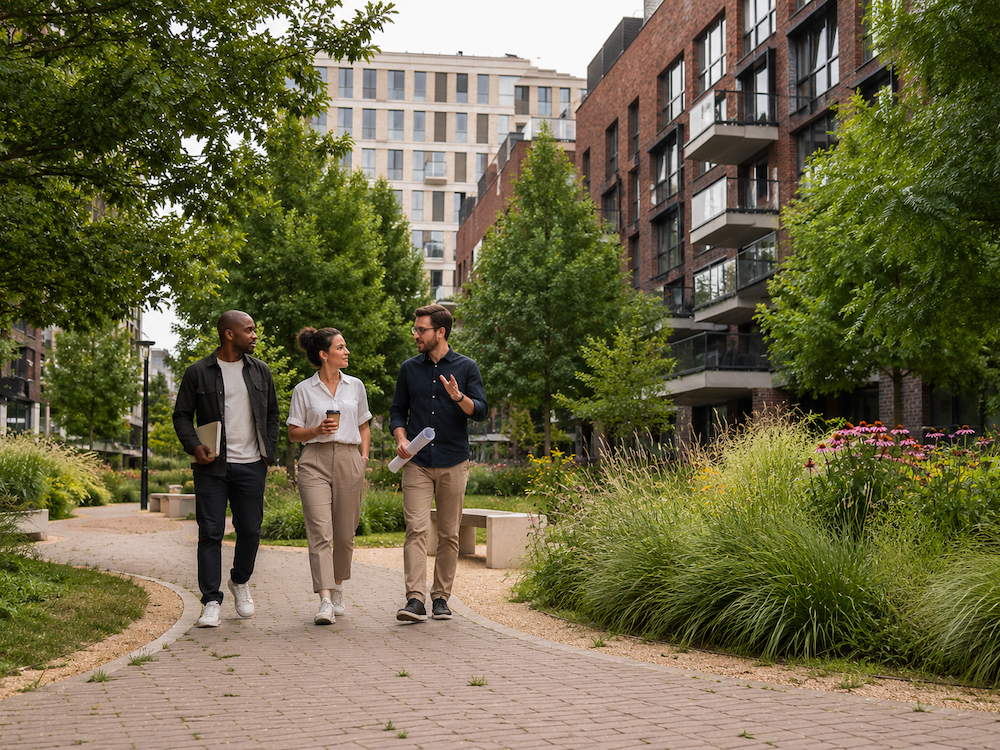
Evolve’s interest in the built world extends beyond sector specialization.
Organizations shape human life.
They influence not only employees and clients, but the places, communities and systems their work ultimately affects.
Built-world leaders therefore carry a particular form of stewardship.
They steward:
people
professional knowledge
institutions
client relationships
resources
communities
places
long-term consequences
That responsibility becomes especially visible when organizations are making choices about growth, development, sustainability, technology, workforce and succession.
The organizations shaping the built world should be as thoughtful about how they are built as they are about what they build.
What we help built-world organizations navigate
Evolve works primarily across four interconnected areas:
Leadership & Succession Transitions
Preparing leaders, leadership teams and organizations for changes in authority, responsibility and institutional leadership.
Executive Team Effectiveness
Strengthening how senior leaders make decisions, exercise shared responsibility, work through conflict and lead the enterprise together.
Organizational Growth & Transformation
Helping organizations evolve their leadership, roles, relationships and ways of working as strategy, technology or market conditions change.
Developing the Next Generation of Leaders
Developing technically accomplished and emerging leaders for broader enterprise responsibility.
These are not separate service lines. They are recurring organizational situations where human development and organizational reality meet.
How Evolve works
Evolve is an organizational development and executive advisory firm.
We work across leaders, teams and organizational systems rather than assuming the problem belongs entirely to one level.
Depending on the situation, our work can include:
executive advisory
organizational diagnosis
executive coaching
leadership development
executive-team development
facilitation
assessment
organizational work
selected governance and role clarification
We stay close enough to understand the organizational context, then focus the work where it can create the greatest value.
The method follows the problem.
Experience across technically sophisticated organizations
Evolve’s work has included leadership and organizational engagements across the built environment, engineering, aerospace, energy, technology and other technically complex settings.
Selected examples include:
Urban Land Institute Washington
A year-long leadership-development experience for leaders across commercial real estate, architecture, engineering, construction, transportation, planning and public-sector development.
Read the case study: Developing Leaders for the Complexity of the Built World →
Confidential Engineering & Architecture Firm
Enterprise-readiness and executive development work during CEO succession and significant organizational transformation.
Read the case study: CEO Succession & Organizational Transformation →
Ball Aerospace
Executive development supporting a senior engineering leader stepping into expanded responsibility, with emphasis on influence, team leadership and organizational impact.
Read the case study: Technical Expertise to Broader Leadership Impact →
Woodside Energy
Enterprise-scale leadership development and coaching across 13 U.S. cohorts and more than 195 managers during post-merger organizational integration.
Read the case study: Woodside Energy Leadership Development →
Across these engagements, the setting changes. The underlying challenge is consistent: helping technically sophisticated organizations develop the human and organizational capacity their future requires.
Building stronger organizations in the built world
Evolve is increasingly focused on the built-world ecosystem, particularly architecture, engineering, construction, commercial real estate and related organizations.
Our work is concentrated in the Mid-Atlantic and Upper Midwest, with selective engagement in the Upper Northeast and strong-fit work elsewhere.
We are particularly interested in organizations taking seriously the responsibility to build enduring institutions, develop capable leaders and create places and systems that serve people well.
What is your organization being asked to become capable of next?
Tell us what you are seeing.