
Case Study: Developing Leaders for the Complexity of the Built World
Client
Urban Land Institute Washington
Engagement
Leadership Development Curriculum Design & Facilitation | 2025–2026
The Context
The Urban Land Institute Washington Leadership Institute brings together emerging and established leaders from across the Washington region’s built environment, including commercial real estate, architecture, engineering, construction, transportation, planning, economic development, government and nonprofit organizations.
The Institute already provided participants with technical learning, cross-sector exposure and project-based experience.
ULI Washington wanted to deepen something alongside that expertise: the leadership capacity required to navigate increasingly complex organizations, communities and systems.
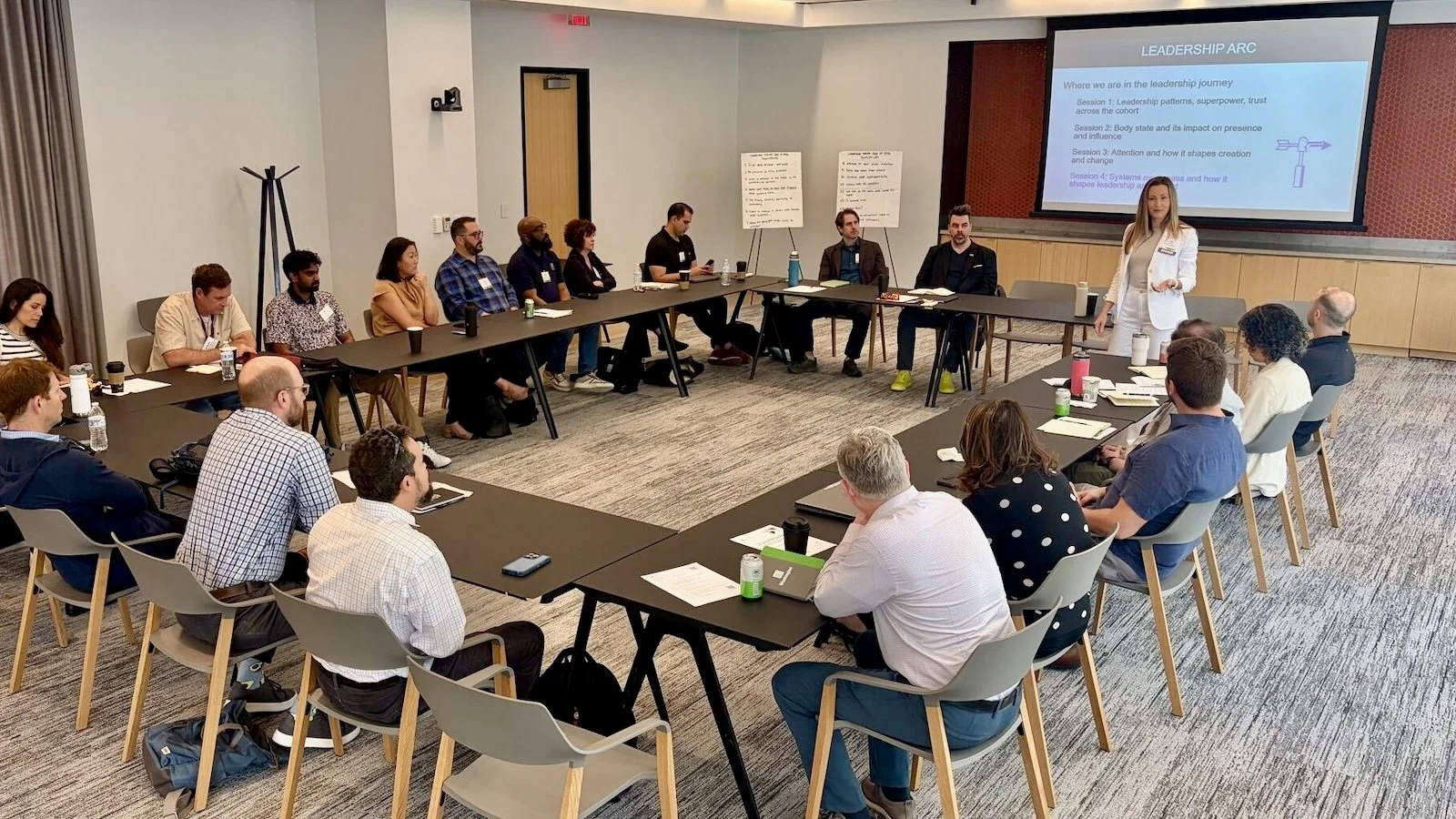
Evolve was engaged to design and facilitate a year-long leadership-development experience integrated into the existing Leadership Institute curriculum rather than delivered as a separate leadership program.
The Challenge
Leadership in the built environment requires far more than technical expertise.
Participants routinely work across:
public-private partnerships
politically complex stakeholder environments
multidisciplinary teams
long-term infrastructure and development initiatives
competing community interests
changing regulatory and market conditions
The challenge was not simply to teach another set of leadership skills.
It was to help accomplished professionals examine how they perceive, relate, influence, innovate and operate within complex systems, while keeping the development directly connected to the work they were already doing.
Leadership needed to become part of how participants understood and practiced their work, not another subject sitting beside it.
The Developmental Architecture
Rather than organize the experience around isolated leadership competencies, Evolve designed a developmental arc that progressively expanded participants’ field of attention:
SELF → RELATIONSHIPS → INNOVATION → SYSTEMS
Across four integrated sessions, participants explored increasingly complex dimensions of leadership.
01 | The Conscious Leader
Core question: How am I leading?
Participants began with themselves.
Using the Leadership Circle Profile and Universal Model of Leadership, they examined leadership strengths, reactive patterns and the assumptions shaping how they operated.
The work also began building the trust required for meaningful development across the cohort.
02 | Power, Influence & Collaboration
Core question: How do I influence others?
The second session moved from self-awareness into relationships.
Participants explored how physiology, regulation, trust, psychological safety and presence affect leadership and influence.
The work connected these ideas to stakeholder relationships and the realities of leading when positional authority alone is insufficient.
03 | Innovation & Quality of Attention
Core question: How does my attention shape what I create?
Innovation was approached not simply as idea generation, but as a question of perception.
Participants examined how habitual leadership patterns can narrow what leaders notice and how greater awareness can expand the possibilities they are capable of seeing.
Innovation became connected to leadership itself: what a leader can create depends partly on what that leader is capable of noticing.
04 | Systems Leadership & Strategic Impact
Core question: How is the system shaping me, and how am I shaping it?
The final session expanded the field again.
Participants explored how organizational norms, incentives, culture, stakeholders, physical environments, identity and industry conditions influence leadership behavior.
They then considered their own capacity to influence those systems intentionally.
The developmental journey moved from understanding oneself as a leader toward understanding oneself as an actor within larger systems.
Leadership Embedded in the Work
Several choices shaped the experience.
Leadership stayed connected to industry context
Concepts were connected directly to issues involving real estate, transportation, sustainability, design, infrastructure, resilience and cross-sector collaboration.
Leadership was never discussed in the abstract.
Development mattered more than information
Sessions emphasized reflection, dialogue, experimentation and application rather than content delivery alone.
Participants continually connected ideas to active leadership challenges within their organizations and Leadership Technical Assistance Projects.
One framework created continuity
The Leadership Circle Profile provided a common developmental language across the year rather than appearing as a one-time assessment.
Later sessions intentionally returned to ideas introduced earlier, allowing participants to see relationships among self-awareness, authenticity, relationships, achievement and systems leadership.
The person and the system remained connected
The curriculum brought together leadership development, organizational behavior, systems thinking, innovation research and attention to the physiological dimensions of leadership.
Participants could therefore examine leadership as an interaction between what happens within the leader and what happens around the leader.
What We Observed
Formal pre- and post-program assessment was not conducted, so Evolve does not claim measured developmental outcomes.
Across the year, however, facilitator observations indicated meaningful shifts in how participants engaged with the work.
Leaders demonstrated:
Greater self-awareness
Participants increasingly recognized reactive patterns, assumptions and habitual ways of operating.
Stronger cross-sector relationships
Peer conversations became deeper and more candid as relationships developed across the cohort.
Expanded systems thinking
Participants increasingly considered the broader conditions influencing an issue rather than treating problems as isolated events.
More reflective leadership
Rather than moving immediately toward solutions, participants increasingly paused to examine their attention, assumptions and choices.
Greater connection between leadership and practice
Participants repeatedly connected leadership concepts to active projects, stakeholder conversations, organizational challenges and real-world decisions.
Development became visible in how participants made meaning of the work they were already carrying.
What the Work Revealed
The engagement reinforced several principles that now shape Evolve’s approach to leadership development.
Leadership development becomes more powerful when it is:
embedded in real work
developmental rather than primarily instructional
grounded in evidence while remaining practical
sustained through a coherent developmental framework
connected to systems as well as individual behavior
But the engagement revealed something larger as well.
The built world is shaped through extraordinarily complex networks of people, institutions, professions, communities, capital and physical systems.
Technical expertise is indispensable.
The capacity to lead across that complexity is equally consequential.
Developing better leaders in the built world therefore has implications beyond individual careers or organizational performance.
Those leaders influence the decisions, relationships and systems through which places themselves are created.
Developing the people shaping the built world
Evolve works with organizations and institutions to develop leaders capable of carrying greater responsibility across organizations, professions and systems.