
Falling Safely: A Primer on the Enneagram
By Jill Barrett, Evolve Impact Founder & Managing Partner
I’ve facilitated Enneagram workshops with individuals and teams for years. Personality assessments remain popular in organizations, alongside an important debate about their ethics, limitations and usefulness. You can read here and here and listen here for some interesting discussions. Yet the curiosity remains.
The Enneagram interests me for a different reason. At its best, it does not simply describe who we are. It helps us see the patterns that constrain us and offers a path toward greater freedom.
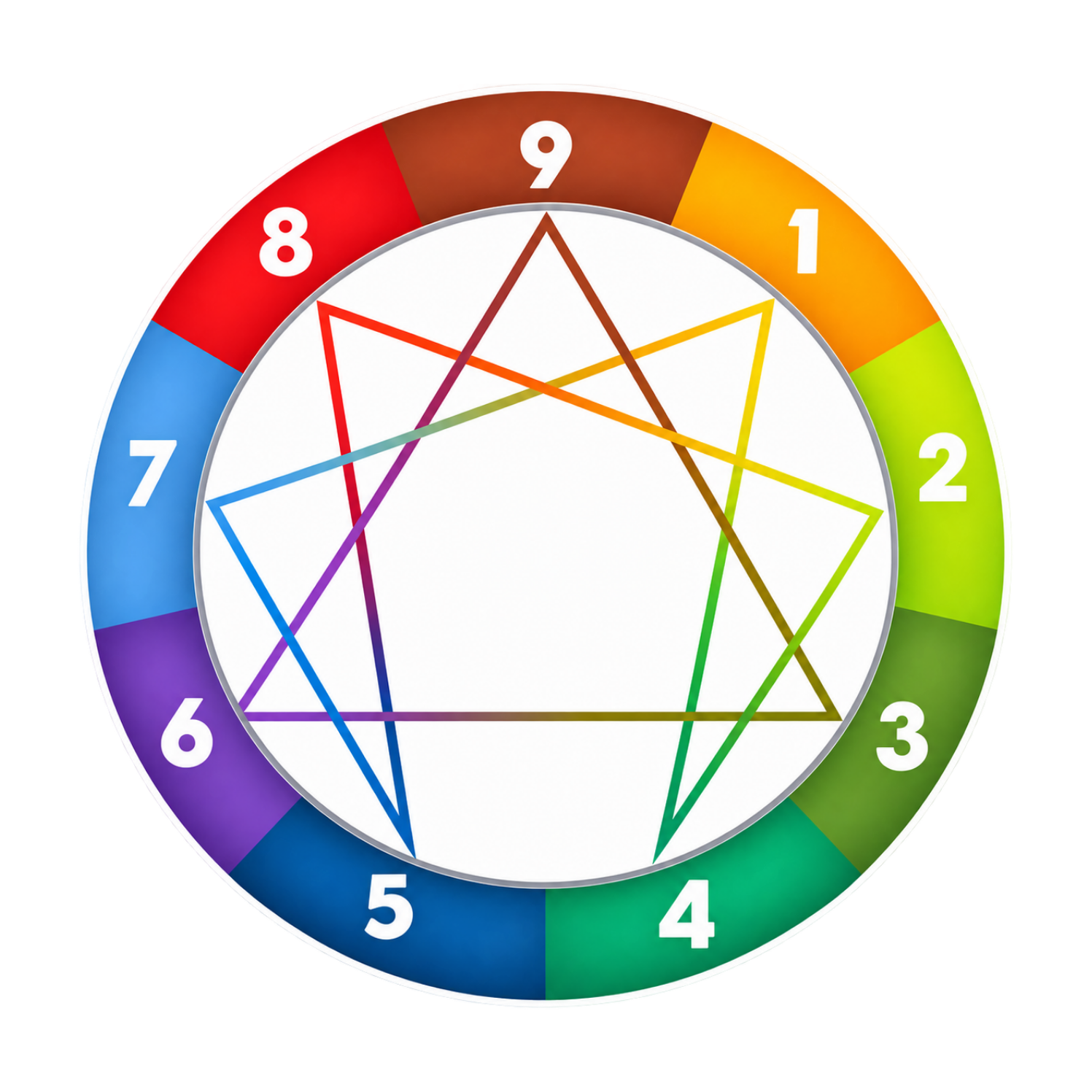
The Enneagram has a complex history, with contemporary teachings drawing from multiple psychological and spiritual traditions. Today, it is used in both organizational and spiritual contexts. In business contexts, it is generally used as a typology to gain insights into workplace interpersonal dynamics; in spirituality, it is more commonly presented as a path to higher states of being and enlightenment. As coaches, we appreciate that the Enneagram leads to self-awareness, self-understanding and self-development in both contexts.
What I find particularly useful about the Enneagram is that it does not stop at personality type. It offers a developmental framework for understanding how our patterns can become more or less constricting. As we move up the pathway, we gain greater access to our essential nature—this makes us clearer, more free, grounded and emotionally available. As we move down the pathway, we become buried under our own self-made defenses—this makes us more anxious, resistant, reactive, emotionally volatile and less free.
If we drop to a certain level in our personality type, we will sense a red flag alerting us that the stakes of our development are ramping up to serious proportions. If we don’t pay attention and change our trajectory, we will drop down even further into very unhealthy levels and need professional support.
A red flag is a blessing.
Some years ago, my red flag started waving. Six years into an unhealthy marriage, I developed a profound sense of alarm that I had no personal power and was on the path to ruining my life. As an Enneatype Four, I experienced great emotional instability. I could feel the pull of depression and I became increasingly alienated from myself and others. Things got so bad that I began to feel unworthy of the very air I was breathing.
By facing my red flag, I began a lifelong journey to be present with my personal truth—and to help others become present to theirs. I remember vowing to honor my belonging on this planet. I intentionally stepped out of my isolation and opened my heart and mind just enough to receive the compassionate support of a therapist. Week after week, we sat together in his Connecticut Avenue office. I brought complete vulnerability to our sessions. No hiding. No defenses. Thanks to his expert inquiry and caring presence, I softened enough to witness my own dignity. Near the end of our time together, I finally felt like I deserved to walk this planet. From this place of belonging, my true self felt safe enough to peek out.
It was around this time that the Enneagram came into my life. I studied the unique ways that I, as an Enneagram Four personality type, hid from danger—real or perceived—since I was a young child. Later, I worked with an Integral Coach who leveraged the Enneagram to help me see a newer, healthier way of orienting myself to danger. She showed me a way that would serve me much better as my adult self. To do so, I needed to let go of my old, childish way. To do so, I needed to imagine, to experiment, to trust in a new way of being.
Today, the Enneagram remains an important part of my own development and one of the frameworks I draw upon in my work with leaders and teams. I have the great privilege of experiencing the wisdom of the Enneagram time and time again.
Breaking down, falling apart, letting go, setting free.
Development does not always look like becoming more capable or adding something new. Sometimes it asks us to loosen our attachment to ways of being that once protected us but have become constraining.
The work of personality, then, can also be a work of release.
Releasing the defenses that have protected us. Releasing what we think we know. Releasing who we think we are. Releasing what we no longer need to make room for something different. Something better.
How can we prepare ourselves to fall? And how can we create more benevolent spaces for one another so that we can fall safely?
Development asks us to loosen our grip on ways of being that once protected us but no longer serve us. That kind of release requires courage. It also requires relationship: people and spaces capable of holding us while something old gives way and something new begins to emerge.
Perhaps that is part of what it means to fall safely: not avoiding the fall, but developing enough trust in ourselves and one another to discover what becomes possible when we let go.